The Arizona bark scorpion requires a deliberate structural barrier because standard baseboard spraying fails against its thick, waxy cuticle and natural climbing behaviors. A bark scorpion measures 2 to 3 inches in…
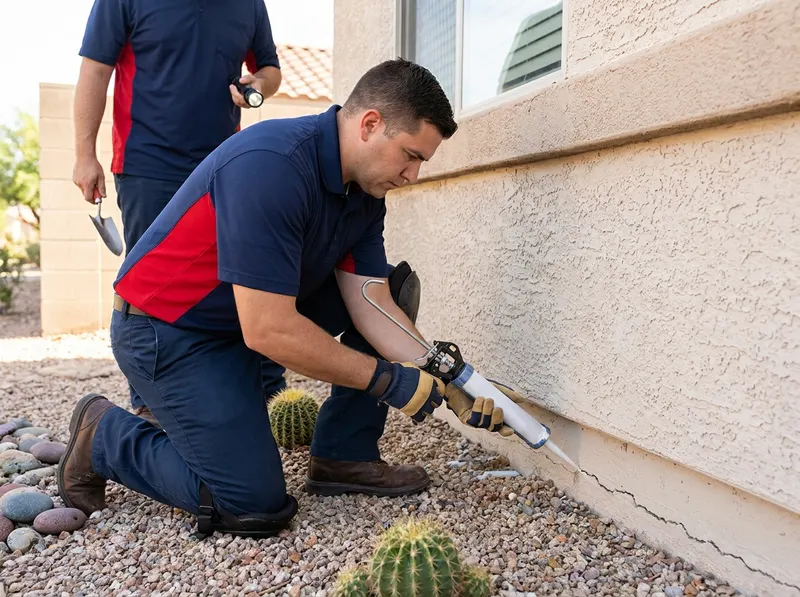
The Arizona bark scorpion requires a deliberate structural barrier because standard baseboard spraying fails against its thick, waxy cuticle and natural climbing behaviors. A bark scorpion measures 2 to 3 inches in length and can pass through any structural opening wider than 1/16 of an inch, such as an unsealed weep screed along a foundation wall. Effective protection relies on mechanical exclusion, which seals physical pathways into the building, combined with microencapsulated exterior residual compounds that remain active under intense Sonoran Desert ultraviolet radiation. This defensive design halts scorpions before they breach interior spaces near bedrooms, baseboards, or ceiling vents.
Neighborhood architecture directly affects exclusion design across Tucson. In the Catalina Foothills, where desert washes border residential lots, loose granite wash areas and natural boulder walls provide dense native scorpion harborage, requiring tight 1/8-inch wire mesh along weep screeds and mortar sealing around flagstone patios. In historic mud-adobe and brick properties throughout Barrio Viejo, Armory Park, and El Presidio, structural settlement creates gaps along stem walls and timber headers that need elastomeric masonry caulking. Mid-century ranch homes in Sam Hughes, Blenman-Elm, and Midtown feature unsealed copper plumbing penetrations and aged weatherstripping that leave direct openings into subfloor zones, whereas modern high-density builds in Civano and Rincon Heights require exterior utility penetrations and garage threshold transitions to be systematically gasketed.
Property owners evaluating perimeter exclusion choose between continuous physical barrier sealing and regular recurring chemical applications. Chemical-only applications target scorpion food supplies, such as crickets and roaches, but breakdown occurs quickly under summer monsoon downpours and soil surface temperatures exceeding 140 degrees Fahrenheit. Structural exclusion provides a permanent physical barrier that stops scorpion transit regardless of weather conditions, though it requires an upfront investment in structural sealing materials. The process follows three defined steps: 1. A physical linear inspection maps every exterior opening greater than 1/16 inch along the foundation. 2. Technicians install copper mesh, stainless weep screed guards, and polyurethane sealants on masonry and plumbing chases. 3. Application of a pet-safe microencapsulated perimeter band along the exterior foundation base blocks immediate exterior approach routes.
Every job gets a firm, written price after a free on-site visit.
Tell us about your bark scorpion perimeter exclusion job in Tucson and we'll send a clear, written quote, usually the same day.
 Brezora Pest Defense