Roof rat biology in southern Arizona diverges sharply from standard house mice. Rattus rattus exploits mature citrus trees, bougainvillea runs, and unshielded tile roof voids, utilizing palm fronds as direct highways…
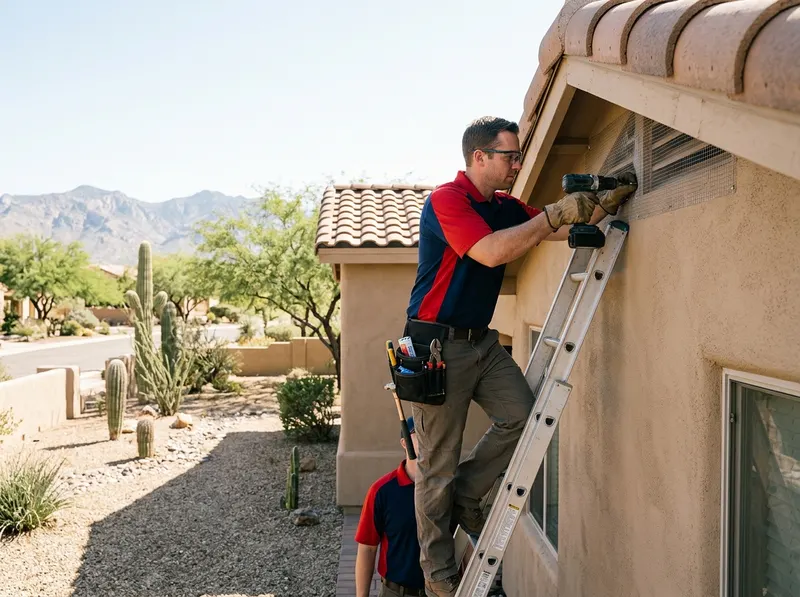
Roof rat biology in southern Arizona diverges sharply from standard house mice. Rattus rattus exploits mature citrus trees, bougainvillea runs, and unshielded tile roof voids, utilizing palm fronds as direct highways into attic spaces. In neighborhoods like Sam Hughes, Blenman-Elm, and Midtown, historic bungalows and adobe properties present open soffits and uncapped chimney crowns. In the Catalina Foothills and Civano, Spanish tile caps and exposed HVAC roof penetrations provide structural gaps larger than a half-inch, allowing rodents immediate passage into thermal insulation. Trapping alone fails when rooflines remain porous; a single female roof rat produces up to 40 offspring annually in unsealed attic voids.
Effective attic defense requires structural exclusion over indoor toxic poisons. Introducing broadcast rodenticide baits into ceilings presents severe secondary poisoning risks to neighborhood raptors and domestic desert pets, while causing dead rodents to decompose unreachable between drywall studs. Mechanical barrier installation utilizes heavy 16-gauge, 1/4-inch galvanized hardware cloth, copper wire mesh, and elastomeric sealants that rodents cannot chew through. Technicians seal roof junctions, dormer vents, Spanish tile bird-stops, air conditioning line chases, and plumbing penetrations. Once all perimeter points measuring over 0.25 inches are sealed, interior mechanical snap traps clear the resident population without chemical fogging.
Properties bordering Tucson Mountain Park, Sabino Canyon Recreation Area, or the dense washes around Rincon Heights encounter heavy invasion pressure during seasonal fruit drops and winter cold snaps. Historic mud-adobe structures in Barrio Viejo, El Presidio, and Armory Park require non-destructive masonry fasteners to anchor galvanized barrier screens to historic parapets. The process follows three distinct steps: 1. Complete exterior-to-interior envelope mapping to identify entry seams, rub marks, and chewed duct insulation. 2. Mechanical installation of rigid wire mesh across eaves, gables, and tile cavities. 3. Interior trap monitoring and final containment clearance until attic sensors verify zero activity.
Every job gets a firm, written price after a free on-site visit.
Tell us about your roof rat attic eradication and exclusion job in Tucson and we'll send a clear, written quote, usually the same day.
 Brezora Pest Defense