Desert fire ants (Solenopsis aurea) present an acute venom risk to desert pets and barefoot children, particularly across gravel perimeters, paver patios, and drip irrigation lines. Unlike non-venomous pavement ants…
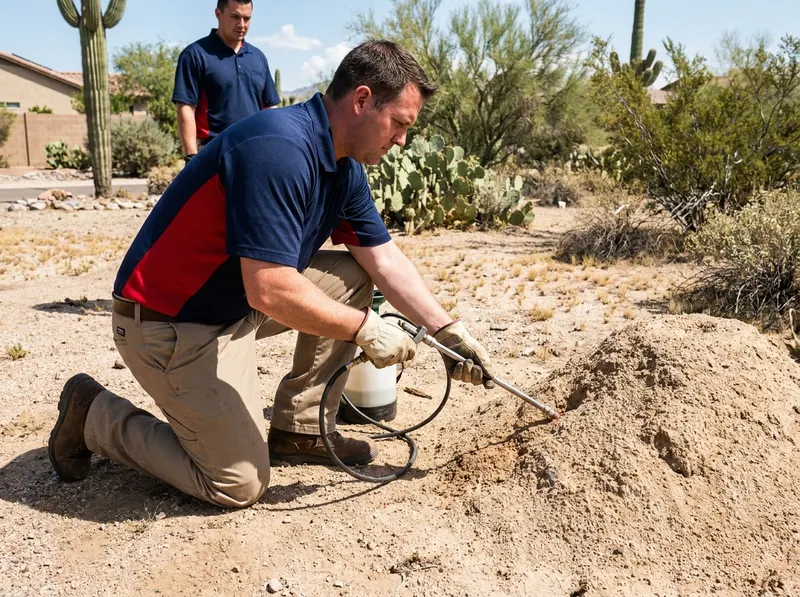
Desert fire ants (Solenopsis aurea) present an acute venom risk to desert pets and barefoot children, particularly across gravel perimeters, paver patios, and drip irrigation lines. Unlike non-venomous pavement ants that create flat, singular dirt mounds, desert fire ant colonies excavate extensive subterranean networks down to 3 feet in caliche soil, constructing irregular, craters of excavated sand. A retail topical spray only eliminates foraging surface workers; it leaves subterranean queens functional, triggering colony splitting or satellite budding across the property. Professional eradication uses pressurized deep-root probe rods to inject systemic, transfer-active chemistries directly into subterranean brooding chambers beneath the visible mound, followed by an exterior band application that intercepts returning foragers.
Neighborhoods spanning historical Midtown, Blenman-Elm, and Sam Hughes with flood irrigation or mature landscape turf require systematic bait placement away from pooling water, whereas the sloping caliche foundations of Catalina Foothills properties demand pressurized subterranean injections to pierce natural rocky barriers. Properties near undisturbed open acreage in Tucson Mountain Park or along dry wash margins face continuous recolonization pressure from alates following summer monsoon rains. The trade-off between perimeter broadcast baiting and direct mound injection rests on timing and moisture: broad-spectrum foraging baits require 7 to 14 days of completely dry ground to allow workers to feed the brood, while direct liquid gallery flooding achieves 100% queen mortality within 48 hours regardless of ambient ground humidity.
Subterranean barrier applications protect exterior systems without introducing aerosol chemicals inside homes. Technicians inspect high-risk attraction zones including HVAC condensation lines, exterior dog runs, and landscape irrigation manifolds commonly targeted by ant colonies searching for hydration during hot summer months. Structural perimeters receive a calibrated non-repellent continuous barrier extending 3 feet up the exterior stem wall and 3 feet outward into surrounding rock mulch or turf. This ensures foraging desert fire ants track active agents back into queen chambers without detecting treatment margins, ending the reproductive cycle without binding homeowners to open-ended monthly service commitments.
Every job gets a firm, written price after a free on-site visit.
Tell us about your desert fire ant mound elimination job in Tucson and we'll send a clear, written quote, usually the same day.
 Brezora Pest Defense