Desert carpenter ants do not ingest cellulose like subterranean termites; they excavate galleries inside wood and rigid foam insulation to house brood. In historic neighborhoods like Barrio Viejo, Armory Park, and El…
Desert carpenter ants do not ingest cellulose like subterranean termites; they excavate galleries inside wood and rigid foam insulation to house brood. In historic neighborhoods like Barrio Viejo, Armory Park, and El Presidio, architectural vigas, support posts, and mud-adobe framing vulnerable to subtle roof leaks attract parent and satellite colonies. In newer builds throughout Catalina Foothills and Civano, these 0.5-inch to 0.75-inch bi-colored ants target wall voids behind stucco where air conditioning condensation lines produce hidden moisture gradients. A complete perimeter defense stops worker foraging trails originating from native mesquite stumps or desert washes before excavation destabilizes structural headers.
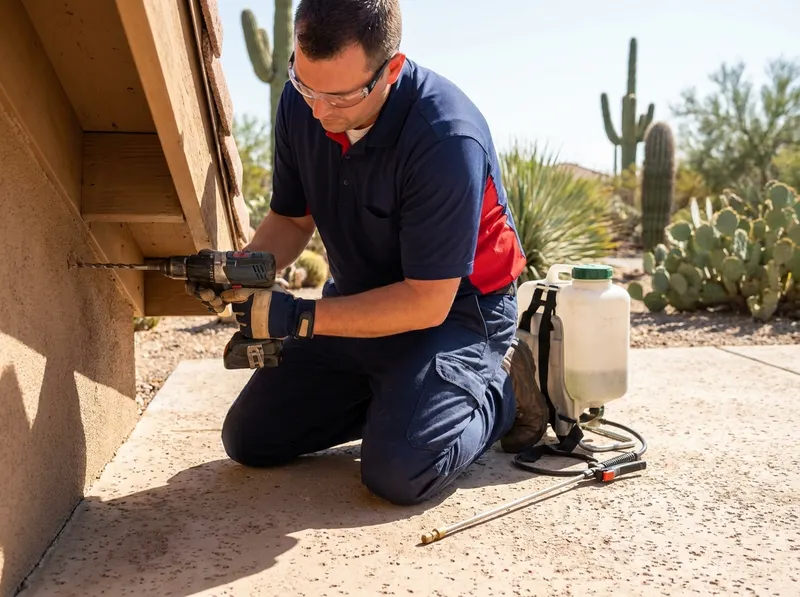
Treatment selection depends on colony maturity and nest depth. If workers are visible along exterior walls near midnight but no interior sawdust is present, a non-repellent exterior perimeter barrier applied 3 feet up the foundation and 5 feet out across gravel beds breaks the foraging cycle. The trade-off is treatment time: non-repellent transfer agents require 10 to 14 days to eliminate the subterranean queen, whereas direct void injection immediately clears active wood excavation inside living spaces. When smooth-edged galleries and piles of insect body parts, known as frass, accumulate beneath window frames in Midtown or Sam Hughes, technicians drill tiny 0.125-inch access holes directly into the drywall framing to deliver localized micro-aerosol dust directly to the nest.
Desert carpenter ant activity surges sharply during Pima County monsoon storms between July and September, when humidity prompts winged reproductive swarmers to seek damp wood. Preventing future colonization requires eliminating wood-to-soil contact, clearing dead saguaro ribs or citrus stumps within 30 feet of foundations, and repairing flashing leaks. Applications dry entirely within 2 to 3 hours, leaving a non-volatile crystalline barrier that is safe for desert dogs, cats, and children once settled, without requiring locked recurring multi-year contracts.
Every job gets a firm, written price after a free on-site visit.
Tell us about your desert carpenter ant wood defense job in Tucson and we'll send a clear, written quote, usually the same day.
 Brezora Pest Defense