Brezora Pest DefenseBrezora Pest Defense

Pack Rat Den Removal and Mechanical Exclusion Tucson

White-throated woodrats gather jumping cholla joints, desert debris, and metal scraps to insulate expansive den middens beneath residential footings, outdoor HVAC units, and low-slung desert landscaping across Tucson.…
Get My Free Estimate →(520) 505-7659
Pack Rat Den Removal and Mechanical Exclusion in Tucson, AZ
Quick answer
  • What is included: Extraction of exterior stick middens, engine bay vacuuming, urine crystallization sanitation, and custom installation of quarter-inch galvanized hardware cloth over structural breaches.
  • Turnaround timeline: Typical residential exclusions take 3 to 6 hours to complete depending on den volume and the number of crawl space entry points.
  • Pricing baseline: Den remediation services start at an established baseline minimum of $250, with complete perimeter structural exclusions scaling based on linear footage and mechanical scope.
  • Targeted rodent species: Interventions focus on desert pack rats (Neotoma albigula) occupying HVAC line chases, pool heater housings, vehicle engine bays, and tile roof caps.
  • Contact protocol: Site assessments are coordinated by calling (520) 505-7659 to schedule an on-site perimeter inspection across Pima County.

White-throated woodrats gather jumping cholla joints, desert debris, and metal scraps to insulate expansive den middens beneath residential footings, outdoor HVAC units, and low-slung desert landscaping across Tucson. In foothill environments adjacent to the Santa Catalina Mountains or Tucson Mountain Park, standard rodent snap traps and chemical baits prove insufficient against resident colonies. Chemical bait boxes leave toxic rodent carcasses inside crawl spaces or engine compartments, posing secondary poisoning risks to predatory raptors and domestic pets. Physical den extraction paired with mechanical exclusion addresses the structural vulnerabilities directly: technicians extract the volume of cacti and stick mass, neutralize territorial pheromones deposited in urine crystallizations, and physically deny reentry using rust-resistant materials.

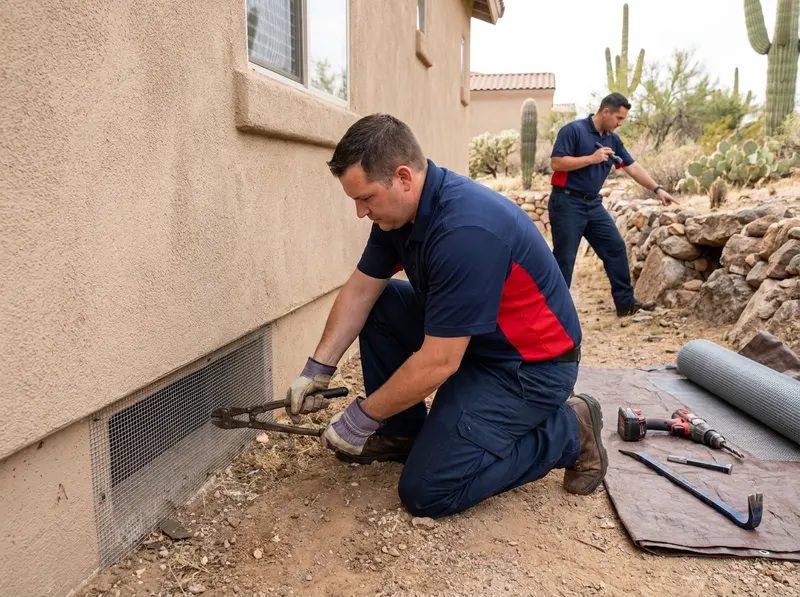
Mechanical exclusion relies on rigid 16-gauge, hot-dipped galvanized hardware cloth featuring quarter-inch grid openings. Woodrats compress through gaps as narrow as one-half inch, chewing pliable plastic mesh, expanding foam, and weathered wood siding to reach attic insulation and electrical conduit. Solid barrier defense requires anchoring steel mesh with mechanical fasteners around AC condenser refrigerant lines, pool pump enclosures, tile eave bird stops, and foundation weep holes. This barrier method eliminates harbor areas around properties in Blenman-Elm and Rincon Heights where older foundations meet expansive desert soils, providing permanent non-chemical containment.

Remediation demands differ between dense urban neighborhoods like Armory Park and naturalized acreages in the Catalina Foothills. Urban historic homes feature raised foundations with ground vents that invite pack rat access during winter cooling trends, whereas suburban properties face heavy nesting in dense stands of prickly pear or beneath ground-mounted solar arrays. The technical trade-off involves prioritizing barrier integrity over temporary clearance: clearing a pack rat den without physically shielding architectural voids leaves entry points open for a secondary dispersing woodrat within 48 to 72 hours. Mechanical sealing establishes a stable physical threshold that prevents continuous mechanical failures.

Pack Rat Den Removal and Mechanical Exclusion cost in Tucson

Single Ground Den Removal & Bio Clean$250 - $450
Vehicle Engine Bay De-nesting & Sanitation$250 - $400
HVAC Chase & Line-Set Mechanical Exclusion$350 - $650
Complete Home Exterior Crawl & Eave Exclusion$850 - $2,400
Property Perimeter Solar Array Mesh Screening$900 - $2,100

Every job gets a firm, written price after a free on-site visit.

Common questions

How does pack rat den removal differ from ordinary rodent control in Tucson?
Pack rat den removal in Tucson physically extracts the extensive structural cactus-and-debris middens built by woodrats, whereas standard rodent control relies on poison bait boxes that leave hazardous biological material and pheromone trails in place.
Why do pack rats in Tucson target car engine compartments and HVAC lines?
Pack rats in Tucson target vehicle engines and HVAC chases because the insulated, sheltered spaces retain radiant heat during winter desert nights while offering soy-based wiring coatings and soft copper tubing that woodrats grind down to maintain their incisors.
Are the materials used in pack rat mechanical exclusion safe for domestic dogs and cats in Tucson?
The quarter-inch galvanized steel mesh and mechanical fasteners deployed across Tucson properties are non-toxic, non-chemical physical barriers that do not introduce secondary poisoning hazards to household pets or native Sonoran wildlife.
How quickly will another pack rat occupy an untreated Tucson nesting site?
An unsealed nesting site in Tucson typically attracts a dispersing woodrat within 48 to 72 hours due to lingering calcified urine markers and structural hollows that signal established shelter.
Does homeowner insurance in Pima County cover pack rat wiring damage?
Homeowner insurance policies across Tucson frequently classify rodent damage as preventable maintenance issues, making mechanical physical exclusion the primary method to prevent multi-thousand-dollar electrical harness and air conditioning repairs.

Get started today

Tell us about your pack rat den removal and mechanical exclusion job in Tucson and we'll send a clear, written quote, usually the same day.

Get your free pest control services quote, Tucson

We only use your ZIP to check availability, no spam.